
Showing posts with label art. Show all posts
Showing posts with label art. Show all posts
Friday, March 26, 2010
Should I launch an online store for helping Papuan Artists Sell their Handicrafts?
Tuesday, March 23, 2010
My other Manokwari Travel blog
I have been writing travel stories about Manokwari city for several years now and they are scattered in blogs, websites throughout the virtual world which is also known as the internet. I want to promote ecotourism for this town hoping that this will help the indigenous people become actively involved in promoting their art, culture and the beauty of their natural environment. For travel stories in bahasa Indonesia language, please see my other blog Lembar-lembar Ekspresi. On the right side of your computer screen, you will see a travel brochure which I have translated into Bahasa entitled Jalan-jalan ke Gunung Meja Manokwari.
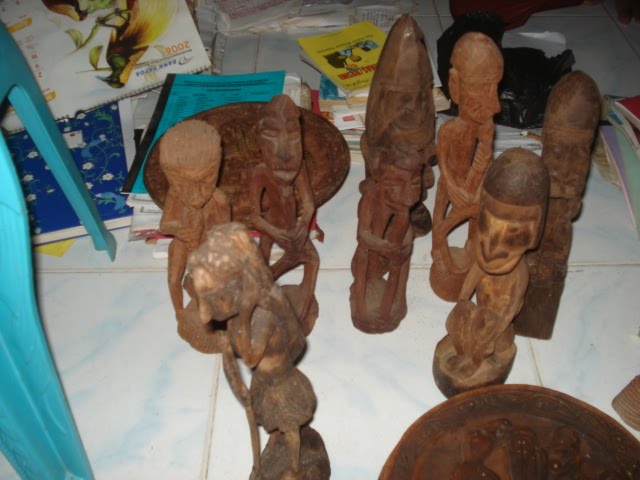
I am now translating another travel brochure into Bahasa entitled Mengunjungi Seniman-seniman Papua which are my stories about my visits to painters, cloth weaver, and wood carvers. Well, these brochures have already been published last week in English. I will try to make them available in Bahasa in order to attract domestic tourists to visit Manokwari Papua. Inside the brochures, you will see beautiful photographs which I shot using my digital photo still camera. The photographs can reveal the beauty of Papua's nature especially the scenery of Manokwari and the artworks which are created by Papuan artists.

Well, to enable people to download the brochures faster, I have reduced the pixel number of the photos making it smaller in size. Tourism is the largest industry in the world whereas ecotourism is the fastest sector of travel and tourism industry that is growing at 15% every year. That's the rate which I got from an ecotourism website. If this is true, then we need to give special attention to this sector and put our efforts to bring as much benefits to the local people and minimize its negative impact to the environment.
Saturday, March 20, 2010
Visiting Papuan Artists My New Travel Guide Brochure

I have just finished writing a Manokwari travel brochure which I call Visiting the Artists in Manokwari of West Papua. Inside the brochure, you can read some of my stories about the brilliant Papuan artists who make artworks at their homes. They just don't care whether people know about them or not. They love art and their lifestyle is fully integrated with art expression.
You might not agree with me but I suggest that you click the link that I provide above and see for yourself how beautiful their artworks are. So, next time when you plan a holiday or vacation trip, please, include us in your travel plans. I will be very happy to guide or escort you (I prefer to choose the latter term) to meet this highly talented artists.
Well, don't forget to bring your digital photo or video camera with you with memory cards that can store thousands of photographs or hours of video recordings. Because it often rains in the tropical region, also bring plastic cover to protect your electronic devices during the rainy season which starts in late November and ends in May or June. I will write more travel guide brochures about Manokwari Papua and provide them for free both in this blog and my manokwaripapua blog. Well, before I close this post, I want to leave you with my watercolor painting entitled: Bird Knitting Nest. This is how a bird makes its nest by knitting pieces of grass at a twig of a tree. Because I optimize the pixel of this image, I set my digital photo camera to web setting.I hope that you are not disappointed with the quality of the photograph, just enjoy this rare scene. Manokwari has a lot to offer if you love bird watching , read my previous travel brochure, Go Hiking in the Table Mountain of Manokwari Papua to know more about it. by Charles Roring

Friday, March 19, 2010
Developing Komplex Missi in Manokwari as Art Palace
The title of this post sounds ambitious but it is reasonable given the cultural assets and the natural and human resources that Manokwari city has. For instance, every year between 4 and 6 February, tens of thousands of people gather along the main streets of this city to participate and to see art and cultural performance at Cultural Carnival. During this occasion, everybody becomes artist. Art creativity of Papuan artists is expressed in various ways along the streets of Manokwari for free during this Gospel Landing Day. I was talking with Lucky Kaikatui, a prominent painter in Manokwari. He has been painting since he was a little boy. We discussed the possibilites of developing the komplex Missi of Manokwari as a hub for art lovers and artists. Here in komplex Missi, Papuan artists live and produce their artworks. Some are painters, carvers, cloth weaver, and singers. Behind our komplex Missi is the protected rainforest of Gunung Meja (Table Mountain) which is now a favorite tourist destination among nature lovers.

To realize this ambitious plan, we are going to hold a meeting for Papuan artists in Manokwari and discuss about what it takes to be an art center. Komplex Missi will be a place where people come to learn art, to express their art inspirations and to appreciate the art that is displayed in the form of painting, carvings, dancing, singing, and various other forms of art
 I don't know how much time do we need to realize our dream. For me, Lucky, Paul and other Papuan artists in Komplex Missi, as well as other artists in this town, the making of Manokwari is the hub for art activities is an interesting challenge. We will do our best. Our works will include creating more artworks, conducting art education to young artists and promoting our art through newspaper, magazines, and the internet. I can only say that this dream will take its long journey starting from today. by Charles Roring

To realize this ambitious plan, we are going to hold a meeting for Papuan artists in Manokwari and discuss about what it takes to be an art center. Komplex Missi will be a place where people come to learn art, to express their art inspirations and to appreciate the art that is displayed in the form of painting, carvings, dancing, singing, and various other forms of art

Friday, February 5, 2010
Norwegian Student Bought Some Traditional Woven Cloth in Manokwari Papua
Mrs. Marice Fonataba, a master of cloth weaving, was very happy this morning. When most of the town dwellers went to Mansinam island to attend the Gospel Landing Day celebration, she was busy showing her hand-made woven cloth to a tourist. A guest from Norway visited her home. Her name is Tan. She is an Indian-Norwegian who is doing a field research on the possibilities of the implementation of UN-REDD program among forest communities in developing countries. UNREDD is launched by the United Nations to empower villagers and to fight deforestation and global warming.

However, Tan came to Ms. Fonataba's house not for interviewing her on things related to UNREDD but to buy some woven clothes which she has made. Ms. Fonataba was one of the few Papuan women who learned the traditional cloth weaving from Sister Aloysia, a Catholic nun who was originally from South East Maluku islands. There, women weave clothes from natural fibers for their families' clothing.
Tan bought a large sheet of woven cloth which costed her Rp. 500,000. As you can see in the photos of this post, she tried some cloth on her body before deciding to buy one.

The development of tourism industry brings positive impact to the local people if they can get various benefits from it. Handicraft makers, artists who create beautiful carvings and paintings should get government's attention. In other words, creative economy should be the backbone of the tourism industry in Manokwari of West Papua.
If you plan to come to Manokwari, I recommend that you buy souvenirs that are created by Papuan artists as the products of their artistic creativity such as hand made woven cloth, wood carvings, postcards or paintings.. Please, DON'T buy souvenirs that are made of corals, or skins or feather of endangered animals such as birds of paradise, white and goliath cockatoo, kuskus and etc. If you buy them, you have encouraged the destruction of marine environment and the huntings of Papuan animals that are facing extinction .

Saturday, January 30, 2010
Linda a Norwegian student visited Manokwari artists
This afternoon I accompanied a Norwegian student visiting some Papuan artists in Kota region of Manokwari town. Her name is Linda. It was around 3:20 p.m. when she arrived at my bookstore. She was walking from Hotel Billy when my sister saw her and picked her up. So, they arrived here by a minibus. After talking for a few minutes and looking at some of my and Paul's paintings, I and Linda walked to the home of Mr. Lucky Kaikatui. He is an oil painting artist. Unfortunately he was in Sorong. So, we could only talk to his wife. Linda took some pictures of his paintings. She said that she was interested in the painting of paradise birds but the size of the artwork was too big for her bag. Linda asked if the artist could make similar painting whose size is smaller. But Mr. Kaikatui's wife could not decide whether her husband would paint it nor mention its price. She said that she would call her husband to discuss Linda's request.

Then we continued our trip to the house of Mrs. Fonataba. She is a master of clothes weaving. She learned this skill from Catholic nuns when she was still young. Many of the women who could make hand made woven clothes have died. Perhaps, she is the only woman in Papua island who is able to manually weave clothes from cotton thread as shown in the photo above. She has taught her daughters and other women in Biak and Serui islands on how to weave clothes in order to pass down her skills to young generations. Mrs. Fonataba looked very happy. She was with her daughter and grand-daughters when we met her. I and Linda took some pictures there. Linda bought some bracelet made of orchid's roots and a piece of shawl, all of these items cost Rp. 210,000 (around 21 US dollars). Mrs. Fonataba said that she needs around one week to make a shawl if it was done as her past-time activity. But if she spends her whole day weaving the cloth, she will be able to finish it in three days.

It was going to rain when we walked to Mr. Awom's house which is located next to Suri bakery. He is a wood carving artist. He was about to go somewhere when we met him. Linda bought a photo frame there and also took some pictures of his nice artworks. The price of the frame was Rp. 100,000 (about 10 US dollars). She said that she could not buy bigger carvings because they are too big to be inserted into her backpack.
Across from Mr. Awom's house was Mrs. Kerewai's studio. Unfortunately, we could not meet her because she was still in Jayapura. She had just participated in an exhibition in Papua New Guinea. Her daughter said that she would be in Manokwari again the next day. There were some handicrafts made of sea shells displayed in Ms. Ruth's (the daughter of Ms. Kerewai) kiosk, but she did not buy them because they were too fragile to be brought in her backpack. Linda said that they will be broken when she arrives in Norway. It was raining when we (I and Paul) said good bye to Linda at the Pertokoan cross-road. She walked back to Billy hotel and we walked back up to our homes at Kompleks Missi area.
This beautiful girl is doing research on the possibility of the implementation of UN-REDD program to support communities living around the forest. UN-REDD stands for the United Nations Collaborative Programme on Reducing Emissions from Deforestation and Forest Degradation in Developing Countries. She will be in Manokwari for around three weeks visiting villages, talking to people, seeing the forest and collecting data.
Across from Mr. Awom's house was Mrs. Kerewai's studio. Unfortunately, we could not meet her because she was still in Jayapura. She had just participated in an exhibition in Papua New Guinea. Her daughter said that she would be in Manokwari again the next day. There were some handicrafts made of sea shells displayed in Ms. Ruth's (the daughter of Ms. Kerewai) kiosk, but she did not buy them because they were too fragile to be brought in her backpack. Linda said that they will be broken when she arrives in Norway. It was raining when we (I and Paul) said good bye to Linda at the Pertokoan cross-road. She walked back to Billy hotel and we walked back up to our homes at Kompleks Missi area.
This beautiful girl is doing research on the possibility of the implementation of UN-REDD program to support communities living around the forest. UN-REDD stands for the United Nations Collaborative Programme on Reducing Emissions from Deforestation and Forest Degradation in Developing Countries. She will be in Manokwari for around three weeks visiting villages, talking to people, seeing the forest and collecting data.
Subscribe to:
Posts (Atom)

